Wednesday, April 8, 2009
Stuff Worth Reading/Random Wednesday

A Training Session
1. Get on the treadmill or elliptical for a 5-10 minute warm up.
2. Static stretch for 5-10 minutes.
3. Head over to a machine and work on "strength training".
Here's what a training session should look like:
1. Soft-Tissue Work - Self Myofascial Release using a foam roller is a perfect way to start a session. The goal being to "loosen you up" and start to get your body ready for the workout.
2. Dynamic Stretching - This is movements to help you work through a range of motion with a specific reason for doing a movement. Static stretching before a workout can actually hinder your workout. So stop holding a stretch for 30 seconds before your workouts!
3. Activation Work - I feel I say this quite a bit while training, but you need to know or teach your body how to go through a movement while activating the right musculature. When you wake up the muscles in individuals bodies that are inactive you're going to see greater gains and in the end leading to you meeting your goals.
4. Strength Training - Whatever your goals may be strength training should be a big part in you path to meeting these goals. Cardio is not the answer to goals. Sure it's going to help but it shouldn't be your number one priority. Even if you're a runner, strength training will help you in your running efficiency and overall economy! Of course there are numerous factors that are different depending on a persons goals.
5. Energy System Work - I love the use of kettlebells or basic body weight movements for this area of work. You don't need to spend hours running on a treadmill to get a aerobic workout. It can be done within 5-15 minutes. Go intensely and your metabolism will be spiked for hours after your workout.
6. Static Stretching - Work on muscles that are problem areas. I see a lot of tight hip flexors, pecs, calves, adductors, and lats.
Simply put, I see a lot of people who don't know how or don't care to put time in for a proper warm up. These first 10-20 minutes of the workout are in my mind and experience the most important. The chronic pain that most people encounter can be relieved once mobility and flexibility is returned to normal.
Monday, March 23, 2009
Post Training Nutrition
After training your body presents these three factors:
1. Glycogen Stores are low
2. Protein Breakdown is increased
3. Muscle Protein Balance is negative
Glycogen is muscle energy. Low glycogen stores mean that there's less cellular energy for daily life and certainly less energy for subsequent workouts. In this situation, training and performance suffer.
Protein Breakdown indicates that body tissues (which are made of protein) are being degraded. Increases in protein breakdown can lead to losses of muscle mass.
Muscle Protein Balance is regulated by the balance between Protein Synthesis and Protein Breakdown in the following way:
Muscle Protein Balance = Protein Synthesis - Protein Breakdown
Failure to rapidly bring the body back into recovery mode (i.e., to increase glycogen stores, to increase protein synthesis, and to prevent protein breakdown), has severeal potential consequences:
1. Prolonged muscle soreness and fatigue.
2. Poor subsequent performances on the track, field, and/or in the gym.
3. Symptoms of and or full-flegged staleness and overtraining.
4. Minimal gains in muscle mass despite a well-designed training program.
5. Losses of muscle mass and a secondary lowering of metabolic rate can occur if volume and intensity get high enough
So what should I be consuming after a workout? A good starting point would be (depending on goals and type of training):
Consume one meal of 0.8g of carbohydrate and 0.4 g of protein / kg of body weight immediately after training. Another meal should be consumed either 60-90 minutes later or normal eating should be resumed eating every 2-3 hours depeding on the individuals goals.
These products below are quality supplements that will help solve this post training deficit. If you need more information or would like to place an order, contact me.
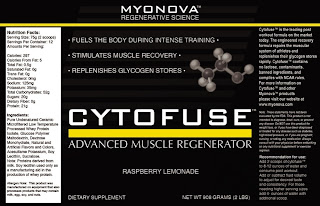
Cytofuse - A pioneer in post workout nutrition, Cytofuse transports the most advanced whey protein available. Formulated with all of the naturally-occurring growth factors and bioactive peptides, Cytofuse is a potent trigger to promote protein synthesis and glycogen replenishment. Some information on the company can be found HERE

Ultra Peptide 1.0/2.0 - Strictly premium proteins such as pure undenatured low temperature processed micellar casein, cross flow microfiltered whey isolates, and hydrolyzed whey peptides. Also included are a small amount of "functional carbohydrates" which can help to assimilate the amino acids into the body in a great tasting form while maintaining low and stable blood sugar levels. Important to maximize lean tissue growth, strongly enhance your immune system, and dramatically speed up your recovery between workouts.

ICE - Branch Chain Amino Acids (BCAA's) actually have the capability to independently stimulate protein syntheses within the muscles and create an anabolic environment during intense training. They also can tremendously reduce the level of soreness in the days following your workouts therefore dramatically speeding your recovery, which of course is of the utmost importance to the drug-free athlete.

Sunday, February 22, 2009
Getting In Shape First?!
"I want to get in shape before I work with a trainer."
For the next month I see them working on on of these:

Here are some reasons to work with a trainer before "getting in shape for a trainer":
1. Imbalances - Try a one leg squat to a bench. I haven't seen a case where one leg is equally as strong as the other leg. I've covered this a bit in an earlier blog but these imbalances not only in your legs can lead to not so nice compensation patterns down the road. This is a big reason your lower back or knees hurt, not your lower back or knees.
2. Muscle Mass - Resistance training is the key to fat loss. Plain and simple the more muscle mass you build, the more fat you are going to burn off while not training. Guess what, you burn off most of your calories while not training. Wouldn't it make sense to build incorporate resistance training to your training, instead of losing muscle mass while going for a jog on that treadmill.
3. Program Design - People like to do things that are easy in most cases. Plain and simple. You can also pick up some new movements instead of using the same ones you've used for the "past 20 years".
4. Diet Tips - I see people who start on their quest in "becoming healthy" start off very well. Or so it seems. Short-term diets are just that short-term. Carb tolerance and carb intake in general is something that is overlooked I think in most cases. Look for a lifestyle change not that quick fix.
5. Each Situation is Different - You shouldn't be following a program that you picked up from someone else that seemed to work for them. Each individual is different and has different things to be addressed. This can lead to quicker results.
6. Exercise Technique - I have clients who come to me with the notion that squats hurt their knees. After about 2 minutes of correcting their form they can squat pain free. This example goes to any other exercise that you perform. If it causes pain by all means stop doing it but in most cases I see form is the problem. Faulty movements lead to pain.
7. Education - Ever heard of self myofascial release? Or used a dynamic warm up? Or know what the main cause of knee/low back pain is? If not that's even more reason to find someone who can educate you on not only these areas but YOUR needs as well.
Thursday, February 12, 2009
Tennis Training

Chronic pain/injuries along with imbalances that are commonly seen with tennis athletes will be taken into account in program design. With the ultimate goal of alleiving these short and long term injuries that many athletes have come to believe are just part of the game.
Modes that will be used in training will be but not limited to bodyweight, foam rollers, dumbbells, kettlebells, barbells, resistance bands, slide boards, gymnastic rings, and medicine balls. Modifications will be made whenever needed to tailor to the individual in a group setting.
Times for the class are as follows (classes are 45-50 minutes):
Tuesday – 8:45 am
Thursday – 8:45 am
Saturday – 1:00 pm
Try the sessions for free on the dates of February 24th, 26th, and 28th at the above times.